

ALUROLL
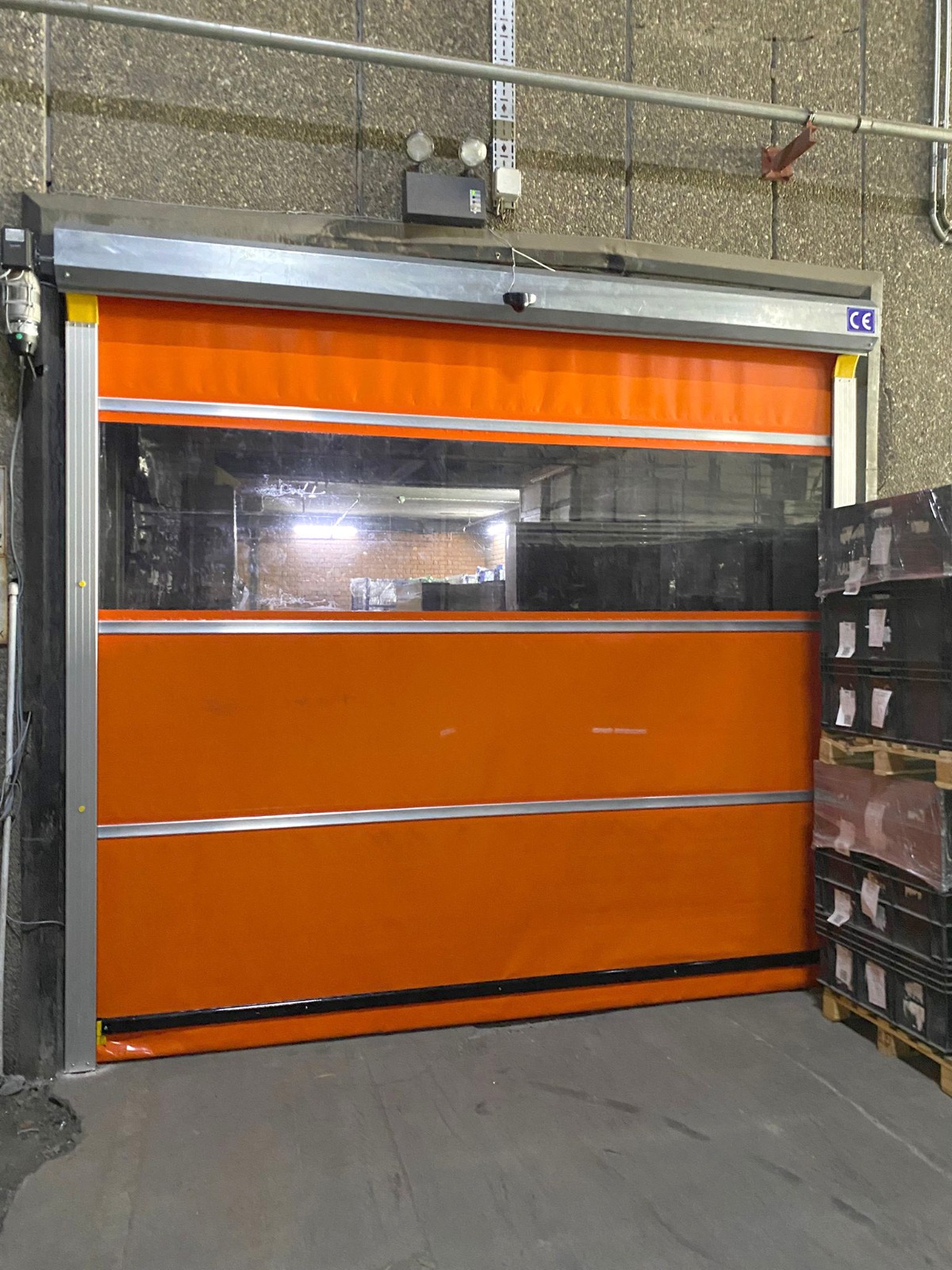
ALUROLL spiral-type high-speed PVC doors are constructed from 900 gr/m² PVC tarpaulin material on both sides, reinforced with aluminum slats at the PVC tarpaulin bonding intervals. They operate by being wound onto a drum, with aluminum uprights on either side acting as guides. A gearbox and motor connected to a shaft drive the single-layer PVC curtain assembly upwards onto the aluminum drum.


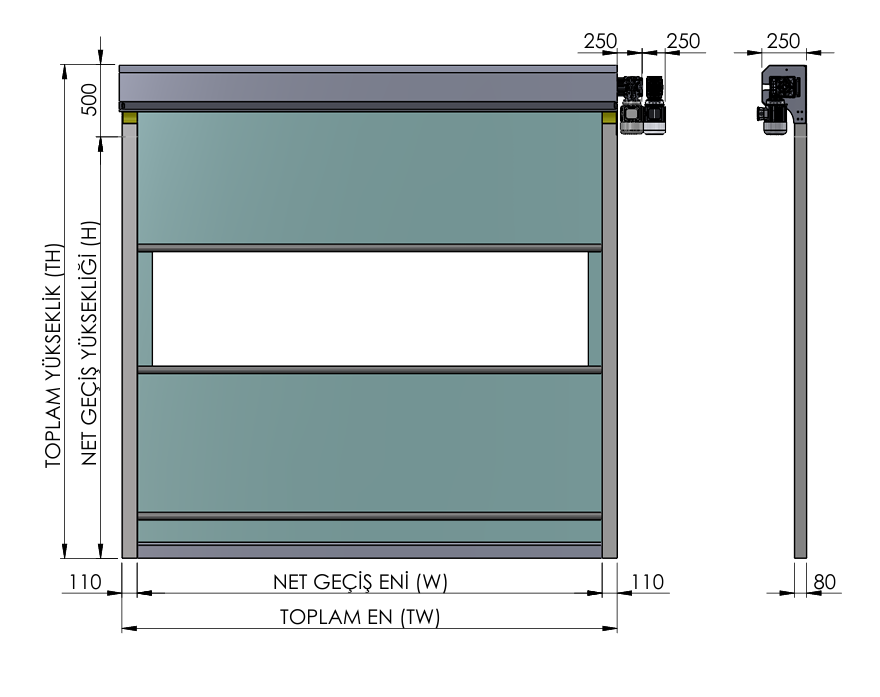
- Door left and right guides must be 80x110 cm, custom-made aluminum. They must have a custom shape to fit the door.
- The door must have an aluminum drum with dimensions of Ø125mm, manufactured using a STORAGE-FREE extrusion method.
- The end sections of the aluminum drum of the door must be joined using CK45 steel grade, Ø25 size, heat-treated and liquid nitrogen-filled; screws, trapezoidal bolts, or similar materials should not be used for joining.
- PVC tarpaulins must comply with DIN ISO 2040, DIN ISO 2075, DIN EN 1876/2 1998 standards, EU 1935/2004 and 10/2011 food standards, be phthalate-free, have a 1100 dtex weft and 1100 dtex warp, be UV stabilized, CE certified, and be a hydrolytic resistant technical textile with a density of 900 g/m2.
- The door must have a protective housing to prevent it from coming out of the guide rail. The protective housing must be made of PVC and POM material, classified as D1 flame-retardant, and resistant to deformation between -30 and +70 degrees Celsius.
- The door's drum PVC winding section must be covered with a 1.0 mm thick, formed DX51DZ quality galvanized sheet metal cover to protect the PVC tarpaulin.
- The side sheet metal flags of the door drum carrier must be laser-cut, 3-5 mm thick, and galvanized, according to ST52 quality door dimensions.
- At the PVC tarpaulin bonding intervals, the specially designed door should be reinforced with aluminum slats to increase wind resistance, according to the spiral dimensions.
- Door guides should be fitted with weatherstripping strips made of PVC and EPDM materials that prevent wind penetration and are resistant to deformation between -30 and +70 degrees Celsius, and are made of Class D1 flame-retardant material.
- PVC tarpaulin; The transparent viewing windows to be applied to it must comply with EN 71-3 standard, EU 1935/2004 and 10/2011 food standards, be phthalate-free, 1.5-2mm thick, and withstand temperatures between -30 and +70 degrees Celsius without deformation.
- The door's lower base section must be a specially designed structure made using aluminum extrusion, and a pneumatic safety system carrier base made of EPDM material must be installed. The right and left ends must have anti-crash features made of PVC and EPDM material, integrated within guide rails to prevent detachment during impact.
- The door's wind resistance must meet Class 1, 2, or 3 values according to EN 12426, EN 12425, and EN 12424 standards, depending on the installation location.
- The door guide surface must include a reflective safety photocell with a capacity of 1-10 meters, conforming to the IEC 60529 IP64 standard, and capable of 5,000,000 operation cycles in working conditions between -30 and +70 degrees Celsius, along with a PVC POM housing to protect the photocell and reflector.
- The motor is a three-phase 230-400V AC IE3 class energy efficient motor with a power output between 0.75kw and 2.2kw, adjustable according to door dimensions.
- The engine must have a cooling system.
- The motor brake must have a response time of 0.2 ms, be 110V-220V, and allow manual shutdown via a brake release lever.
- Depending on the dimensions of the installation location, the door opening speed should be between 60 m/s and 0.70 m/s.
- The switch module mounted on the gearbox controls the up-down level and the precision of the door's stopping points.
- The switch system must comply with IP 51 (CEI EN 60529), EN 60947-5-1, CEI EN 60947-5-1 EN60529, CSA 22.2-14 standards and have a capacity of 2,000,000 cycles under operating conditions between -30 and +70 degrees Celsius.
- The door's control panel must be a 30x40 plastic panel conforming to EN ISO 12100 Machine Safety standards, using Hyundai or LG switchgear and V23 microcontrollers.
- The door must have a safety system that automatically cuts off the electrical circuit while it is in use.
- The door control panel; a 380V AC control panel with an LCD screen or similar display should be supplied with the door.
- The door must have an automatic closing feature adjustable from the control panel.
- The door's motor operating time is adjustable from the control panel.
- The door should be able to be opened, closed, and stopped via the control panel.
- The door must have a button with up and down controls, in addition to the controls on the control panel.
- The door must have an EMERGENCY STOP button on the control panel.
- The door's airlock system must be integrated into the control panel.
- The door must have an identification label on the control panel containing the production date, serial number, and manufacturing dimensions.
• An optional engine housing should be available.
• Optionally, thick aluminum slats should be available for large doors.
• An optional height photocell should be connectable.
• An optional warning lamp or signaling system should be available.
• An optional lower contact pneumatic safety system should be available.
• An optional exprof engine should be available.
• Optionally, it should be possible to manually turn the device on in case of power outages.
• An optional radar system should be available.
• An optional remote control system should be connectable.
• An optional input/output metal mass detector should be connectable.
• Motor housings should be available as an option for exterior doors.
• Optionally, the motor should be able to operate between -30 and +70 degrees Celsius, and the gearbox should be equipped with seals, gaskets, and an oiling system.
• Optionally, an inverter can be installed to increase the speed up to 1 m/s, depending on the gate size.
• The number of windows should be expandable as an option.
• All features to be optionally connected to the door; should not require any additional products beyond the optional features, and should be directly applicable during the panel connection phase.